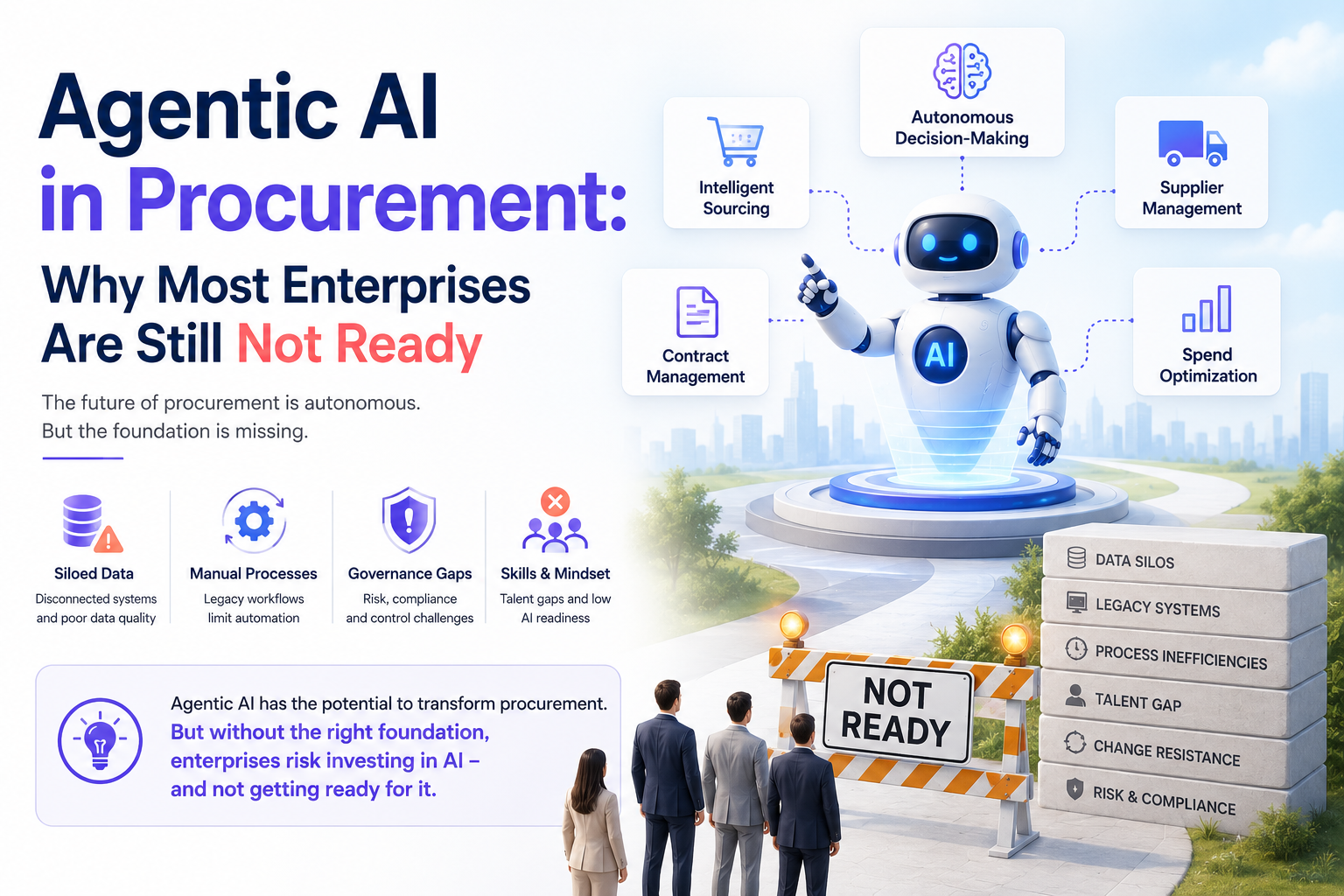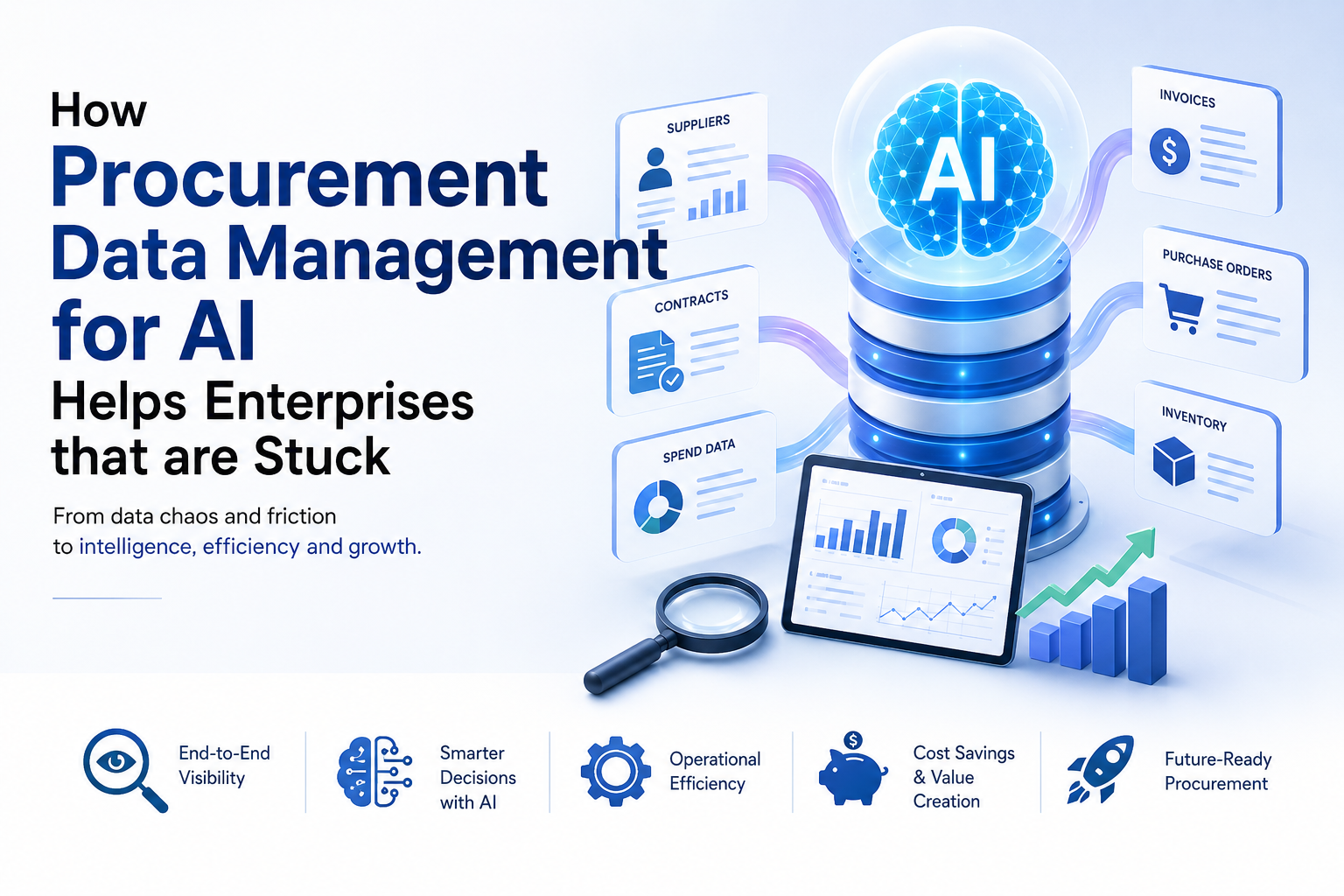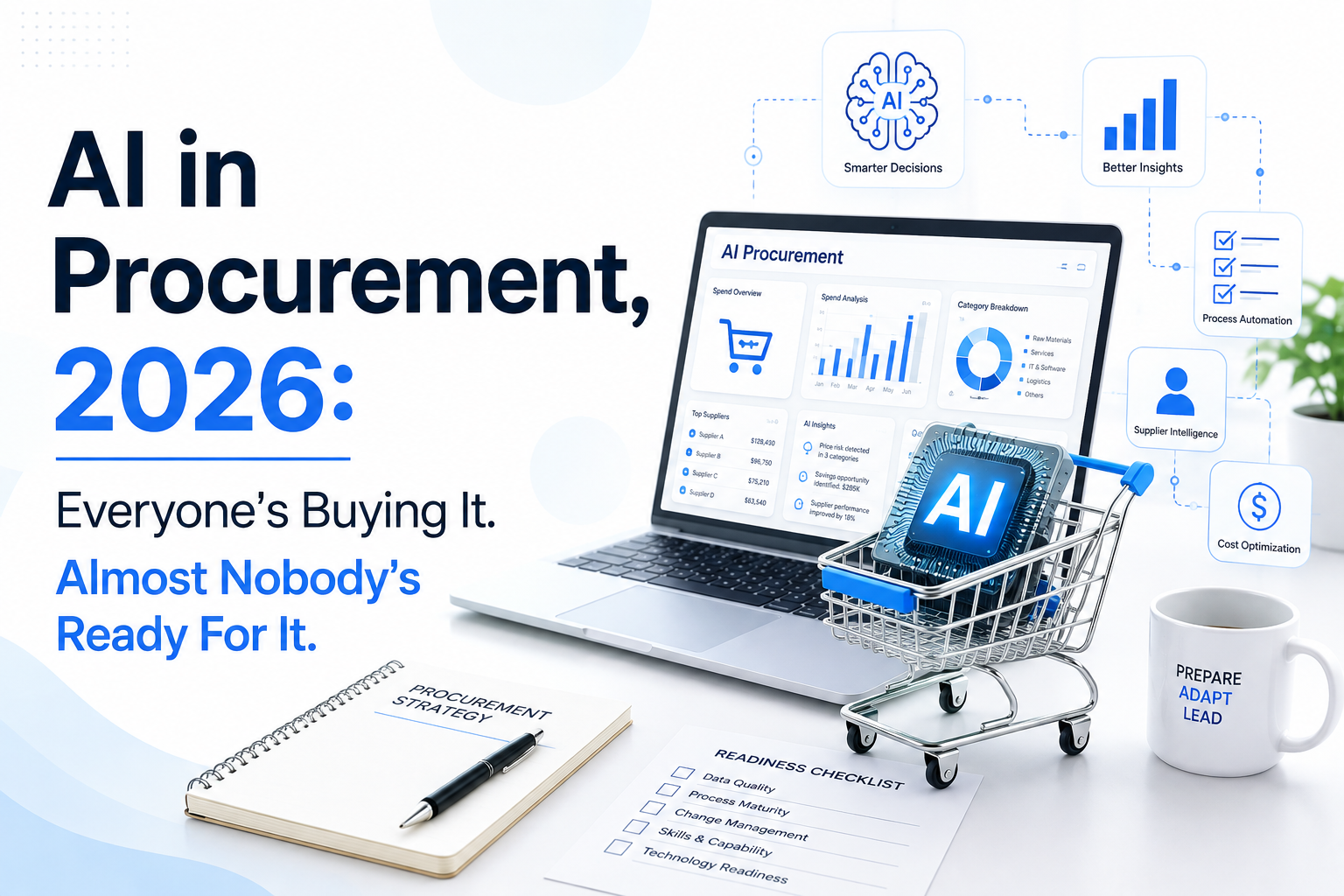
Here’s 2026 in four numbers: 90 percent of procurement leaders are adopting, or planning to adopt, AI agents. 94 percent of procurement executives now use generative AI weekly. The global AI-in-procurement market has grown to roughly $4.25 billion this year, up from $3.32 billion in 2025. And yet only 36 percent of procurement teams have anything they’d call a “meaningful implementation” running in production. That last number is the one worth sitting with.
Every procurement conference this year has the same energy. Vendors on stage promise “autonomous sourcing” and AI agents that negotiate contracts on their own. CPOs in the audience nod along. LinkedIn is full of hot takes about the death of manual procurement. Ask one of those same CPOs privately what’s actually running on their desk day to day, though, and the honest answer is usually a couple of pilots, a chatbot bolted onto an old ERP, and a spreadsheet that still does the real work.
That gap — between how procurement talks about AI and how procurement actually uses it — is the real story of 2026. Not the hype. The gap.
KEY TAKEAWAYS → 90% of procurement leaders are adopting AI agents, but only 36% have a meaningful implementation actually running in production. → The gap comes down to three things: clean spend data (74% say theirs isn’t ready), a narrow starting process, and clear ownership of exceptions. → Touchless invoice matching (up to 87% automation) and spend analysis are the two use cases already delivering measurable ROI. → Sourcing, contract review, and ESG-linked supplier scorecards are the next wave — 42%, 41%, and 70% adoption respectively. → The global AI-in-procurement market grew from $3.32B (2025) to $4.25B (2026), a 28% CAGR — budget is following outcomes, not hype. |
Numbers That Don’t Quite Add Up
Start with the headline figures again, because they’re worth unpacking. Ninety percent of procurement leaders say they’re adopting, or planning to adopt, AI agents in their workflows. Ninety-four percent of procurement executives now use generative AI weekly — a jump of 44 percentage points in just a few years. Read those two numbers on their own and you’d assume procurement had already gone fully autonomous.
Then look at what’s actually running in production. Only 36 percent of procurement teams report a “meaningful implementation” of AI — not a trial, not a demo, an actual system touching real spend. And when researchers ask organizations point-blank whether they’re ready to run AI at scale, 89 percent say no.
Dig into why, and the mystery disappears fast. Seventy-four percent say their underlying data isn’t clean or structured enough for AI to work with reliably. Fifty-seven percent point to siloed systems — procurement, finance, and ERP tools that were never built to talk to each other. Sixty-seven percent list data privacy and compliance as their top concern before rolling anything out further.
So the real question for 2026 isn’t “is AI coming to procurement.” That’s settled. It’s why the gap between intent and reality is still this wide — and what actually separates the teams closing it from the ones stuck in pilot purgatory.
Why 2026 Specifically
Every year since ChatGPT launched has been called “the year of AI,” so it’s fair to be skeptical that 2026 is any different. But three things changed this year that didn’t exist two years ago. First, budget followed talk: roughly a quarter of top-quartile CPO technology budgets are now earmarked for AI-related tools, not just piloted with leftover innovation funding. Second, the efficiency case got specific — researchers now estimate agentic AI can lift procurement efficiency by 25 to 40 percent, and that somewhere between half and four-fifths of current procurement work is technically automatable with generative AI today, not in some future release. Third, and quietly the most important, accounts payable caught up: roughly 87 percent of AP teams expect to be using AI by 2027, up from about half today, which means the finance side of the house is finally moving at the same pace as procurement instead of being the bottleneck.
None of that means the gap closes on its own. It means the excuse of “the tools aren’t good enough yet” stopped being true for most use cases. What’s left is the harder, less technical problem: data, scope, and ownership.
What “AI-Ready” Actually Means
Strip away the marketing language, and three things tend to separate procurement teams getting real value from AI from teams still running pilots eighteen months in.
The first is unglamorous: clean, connected spend data. Not perfect data — nobody has that — but spend that’s tagged consistently enough, across entities and currencies, that a model can classify it without someone quietly fixing half the results afterward. Teams that skip this step usually end up with a tool that looks impressive in a demo and falls apart the first week it touches messy production data.
The second is scope discipline. The teams making real progress didn’t try to automate the entire source-to-pay chain in one go. They picked one process that was genuinely painful — usually invoice matching or spend classification — proved measurable value there, and only then expanded. The teams stuck in pilot purgatory tend to be chasing an all-at-once “autonomous procurement” vision before they’ve automated a single workflow end to end.
The third is ownership. AI doesn’t run itself quietly in the background. Someone still has to review the exceptions it flags, tune it when it gets something wrong, and be accountable when a supplier payment doesn’t match. Teams that treat AI as install-and-forget software are usually the ones who quietly stop using it six months later.
Where the Payoff Is Already Real
This isn’t all readiness gaps and caveats — the return is real where teams have actually cleared that bar. Touchless invoice processing is the clearest example: AI-driven three-way matching, comparing invoices against purchase orders and receipts, is now automating up to 87 percent of that work at organizations that have implemented it well, catching duplicate payments and mismatches before they ever reach a human’s desk.
Spend analysis is the other early win. Instead of an analyst spending weeks tagging thousands of transactions across currencies and business units, AI classifies that spend in something closer to real time — a big part of why 53 percent of CPOs say spend analytics is their top priority use case for AI right now.
Supplier risk is shifting too, from an annual review exercise to something closer to continuous monitoring — tracking a supplier’s financial health, compliance status, and delivery performance as it changes, not once a year on a spreadsheet. That shift is part of why the money is following the results: the global AI-in-procurement market grew from roughly $3.32 billion in 2025 to about $4.25 billion in 2026, and it’s expected to keep growing at close to 28 percent a year through the early 2030s. That’s not hype money. That’s budget following outcomes.
Not sure where your own spend data stands? ProcureSignal’s free vendor risk analysis and spend categorizer tools will show you, in a few minutes, roughly what shape your data is in before you commit to a bigger rollout. |
The Use Cases Getting the Real Investment
Beyond invoice matching and spend analysis, two other use cases are quietly pulling ahead of where most people assume procurement AI is in 2026. The first is sourcing. AI can now draft a first-pass RFP or RFQ from a category brief, score supplier responses against weighted criteria, and surface the handful of vendors actually worth a human’s time — work that used to take a sourcing manager days and now takes hours, which is part of why sourcing cycles at AI-enabled organizations are running 30 to 50 percent faster than they were a couple of years ago. Forty-two percent of procurement teams already use AI this way, which puts it just behind spend analytics as the most-adopted use case.
The second is contract management, and it’s the one that surprises people most. Reviewing a contract for risky clauses, missing indemnification language, or non-standard payment terms used to require a lawyer or a very patient category manager reading line by line. AI-assisted contract review can now flag those issues in minutes and route only the genuinely ambiguous ones to legal — 41 percent of procurement teams report using AI for exactly this, for contract summarization and key-term extraction, and roughly half of organizations expect AI-enabled contract negotiation to be standard practice by 2027.
Sustainability reporting is riding along with both of these. As more procurement teams get asked to prove ESG compliance across their supplier base, the same AI systems tracking spend and risk are increasingly tracking sustainability metrics too — about 70 percent of organizations plan to build ESG data directly into supplier scorecards, which turns an annual compliance headache into something that updates itself.
Use case | Adoption today | What it automates | Reported impact |
|---|---|---|---|
Spend analysis | 53% | Transaction classification across entities & currencies | Real-time spend visibility |
Invoice processing | ~50% | Three-way matching (invoice / PO / receipt) | Up to 87% touchless |
Sourcing & RFx | 42% | RFP/RFQ drafting, supplier scoring | 30–50% faster cycles |
Contract management | 41% | Clause review, key-term extraction | Minutes instead of hours |
Supplier risk | 60–70%* | Continuous financial & compliance monitoring | Issues caught before renewal |
*Projected adoption by 2027.
The Trade-Offs Nobody Loves Talking About
It’s worth being honest about the parts of this that are genuinely uncomfortable. Just over half of procurement professionals — 51 percent — say they’re worried about AI replacing human judgment in supplier decisions, and that concern isn’t irrational. A model can flag a risky clause or a price outlier; it can’t yet read a supplier relationship the way an experienced buyer can.
There’s also a security dimension becoming non-negotiable rather than optional. As more procurement systems touch sensitive financial and vendor data, cybersecurity requirements are being written directly into contracts — an estimated 95 percent of U.S. federal contracts are expected to include cybersecurity clauses by 2027, and that expectation is trickling into private-sector procurement too.
None of this is a reason to wait. It’s a reason to be specific about what you’re automating and why, instead of buying “AI” as a category.
Closing the Gap: What Actually Works
If there’s one lesson buried in the numbers above, it’s that the 89 percent stuck in “not ready” and the 36 percent with real implementations aren’t separated by budget or ambition. They’re separated by sequence. The teams that got somewhere didn’t start with the AI tool — they started by auditing what their spend data actually looked like, picked the one process where a mistake was cheap and the ROI was easy to measure, and only expanded once that process was working, not just impressive in a pilot. That’s a less exciting story than “autonomous procurement agents,” but it’s the one actually showing up in the data.
A Simple Way to Audit Your Own Readiness
You don’t need a consultant or a maturity framework with a dozen dimensions to figure out where your team actually stands. Three honest questions do most of the work.
Can you pull last quarter’s spend, cleanly categorized by vendor and cost center, in under an hour? If that requires stitching together three exports and a few hours of manual cleanup, that’s your real starting point — not the AI tool, the data underneath it. Is there one process you’d trust a machine to run with light supervision, and can you say specifically what “success” looks like for it in numbers? If the honest answer is “we’d want AI to help with everything,” that’s the all-at-once trap talking, not a plan. And if that one process breaks — an invoice gets mismatched, a supplier risk flag turns out to be wrong — is it obvious whose job it is to notice and fix it? If nobody’s name comes to mind, ownership is the gap, not the technology.
Teams that can answer all three specifically are usually much closer to the 36 percent than the 89 percent, regardless of how much they’ve spent on tools so far.
Where ProcureSignal fits This is roughly the problem ProcureSignal was built around. Rather than promising a fully autonomous procurement department, it focuses on the specific, high-friction parts of source-to-pay — spend analysis, sourcing, invoice matching, and supplier risk monitoring — where AI agents can categorize, match, and flag transactions with a clear, measurable outcome, usually within the first few weeks. If your team recognizes itself in the “89 percent not ready” statistic more than the “36 percent with real implementations” one, that’s less a reason to avoid AI and more a reason to be deliberate about where you start. |
A Few Honest Questions
Is AI in procurement actually worth adopting in 2026, or is it still mostly hype?
Both things are true at once. Adoption intent is real and market investment is accelerating, but most organizations aren’t yet capturing the value — only 36 percent report a meaningful implementation. The technology delivers where teams have prepared their data and picked a narrow starting point; it’s still mostly hype where they haven’t.
What’s the single biggest reason procurement AI projects stall?
Data. Seventy-four percent of organizations say their spend data isn’t structured or clean enough for AI to work with reliably — and that problem tends to surface only after the project has already started.
Will AI replace procurement jobs?
Not in the way headlines suggest. It’s automating specific, repetitive tasks — invoice matching, spend classification — not judgment calls like negotiation strategy or supplier relationship management. The 51 percent of professionals who worry about this aren’t wrong to think about it, but the roles disappearing are the ones built entirely around manual data entry.
How long before a company sees real results?
Teams that start narrow — one process, clean data, clear ownership — tend to see measurable results within a few weeks. Teams that try to automate the whole source-to-pay process at once tend to still be “piloting” a year later.
Which procurement processes should a team automate with AI first?
Invoice matching and spend classification are the two most common starting points, and for good reason — they’re high-volume, rules-based enough for AI to handle reliably, and easy to measure against a clear before-and-after number. Sourcing and contract review are strong second steps once that first process is genuinely working, not just live.
How is AI in procurement different from a traditional procurement software upgrade?
A traditional system digitizes a process that’s still run by rules a human wrote — approval thresholds, routing logic, fixed workflows. AI adds judgment on top of that: it can classify spend it’s never seen before, flag a contract clause that doesn’t match any predefined rule, or notice a supplier risk pattern nobody explicitly programmed it to look for. That’s a meaningfully different kind of system, which is also why it needs cleaner data and clearer ownership to work well.
Last Word
The AI-in-procurement story in 2026 isn’t really about the technology — the technology already works, in the places teams have bothered to prepare for it. It’s about whether a procurement team is willing to do the unglamorous part first: cleaning up data, picking one process, and being honest about who owns the outcome. The teams doing that quietly are the 36 percent already seeing results. Everyone else is still just talking about it on a conference stage.
Sources
Market size, CAGR, and regional data: Precedence Research — AI in Procurement Market
Adoption, implementation, and readiness benchmarks: Art of Procurement — State of AI in Procurement 2026
Compiled automation, workforce, and compliance statistics: Procurement Tactics — 60 Procurement Statistics for 2026
Original survey data cited via the sources above: Deloitte’s 2025 CPO Survey, Gartner, Hackett Group, Verified Market Research, ProcureCon, and the U.S. Bureau of Labor Statistics.